Saturday, August 29, 2015

Let's Review! Call of Duty Black Ops III Beta

Let's Review! Call of Duty Black Ops III Beta

This year, Call of Duty fans are receiving the gift that is Black Ops III (Blops 3) from Treyarch. As FPS players have come to expect, the release has been preceded by a Beta which took place from August 19th - August 23rd for PS4 owners and from August 26th - August 30th for Xbox One and PC players. Initially I had been told that in order to participate in the Beta you had to either receive a key from a friend or pre-order Blops 3. With the added exception for PC being, you need to own CoD Ghosts, Blops 2, or Advanced Warfare. Much to my empty wallet's delight, the PC beta turned out to be free for anyone since the only CoD I own for the PC is CoD 4: Modern Warfare. So, on Friday August 28th I jumped into the PC beta and I had an absolute blast. Let's review!

The Good


  • Wall running and power sliding. I really enjoyed the double jumping and slamming mechanic in Advanced Warfare. In addition to carrying over the double jumping mechanic (it is slightly tweaked though), Treyarch added wall running and power sliding (to replace dolphin diving) and it was definitely the right choice. In additional movement options opens up levels and allows what would be a traditional one directional lane to be traversed in four different ways. It is great. It's also interesting to see how the mechanic is balanced. The player has a power bar which gets used whenever the double jump or power slide and the double jump height/duration is influenced by how long the player holds the jump button down. Hold it down the maximum time allotment and the player will jump really high but use all their power. Timing also plays a part as the player can time the second "jump" and turn it more in a floating stall into a ledge grab since the exo suits are gone and players now have this sort of cyborg thruster suit.


  • Pick 10 system. I absolutely loved it when the pick 10 system was introduced and I'm glad it's making a return in Black Ops III. It gives players more freedom and customization over their player classes than the majority of other FPS games and even older CoD games.


  • Specialists. Like the wall running and power sliding, Blops 3 introduces "Specialists" into the game which is like having an extra kill streak for no extra cost. Each specialist has one offensive and one defensive pointstreak (you can only use one at a time), which accrues throughout the entire match, as opposed to the actual kill streaks that reset when the player dies. The specialists add some much needed character/character customization to the multiplayer since they all have call signs and they talk to each other at the beginning of each match. It is kind of weird that the multiplayer player character isn't physically customizable or influenced by the perks (see ghillie suit in Blops 1). I had the opportunity to play as "Prophet", "Outrider", "Battery", and "Nomad". "Prophet"'s offensive point streak is a rail gun that fires electric projectiles which apparently can hit multiple enemies, but I was unable to accomplish this feat myself and his defensive point streak is "glitch" which allows the player to teleport back to where they were 30 seconds previous to using the skill. "Outrider"'s offensive point streak is a bow with an explosive arrow and her defensive skill is like wall hack vision. "Battery"'s offensive point streak is a multi-explosive grenade launcher and her defensive ability is armor invincibility. "Nomad"'s offensive weapon is H.I.V.E., another rocket launcher type weapon but instead of firing explosive rounds it fires a proximity mine of bugs that swarm and kill enemies that set it off. His defensive skill detonates a big cloud of smokey lightning when he dies and then revives him; it's useful against players that aren't familiar with it, but once you've played for a while it's easy to just camp and kill "Nomad" twice. Of course, the point streaks are balanced so they stop when the player is killed, the player runs out of their limited ammo, or the time duration of the point streak ends (whichever happens first).


  • The guns. I spend most of my Call of Duty time in CoD 4: Modern Warfare mainly for modding purposes so it's really refreshing playing a modern CoD (hah, get it?) where there are more than four guns in most of the weapon categories and a wider range of customization options/slots which do more than add a sight or stability to the gun.


  • The unlock/reward system. If it's one thing CoD games do well, it's getting the player to continue to play the game trying to unlock items as if they were playing an MMORPG. In addition to the usual fair of unlocking kill streaks, specialists, player cards et al., perks, weapons, and attachments; the level up system is split into character level AND weapon level. In order to unlock attachments for weapons you have to level up said weapon by using it to kill enemies. It's just a simple change, but in addition to giving players a reason to level up regularly, players now have a reason to use different weapons other than they're not a high enough level for the really good weapons.


  • New killstreaks. There are many updated versions of classic kill streaks like the explosive rc car, UAV, counter-UAV, and care package. However, a lot of the classic airborne kill streaks are hybrids. For instance, there is a killstreak called "Hellstorm" which is kind of like a combination of the Predator Missle from MW2 and the Mortar Team from Black Ops. Another killstreak of note is R.A.P.S. which are tiny AI explosive robot balls that function like the Dogs from Black Ops; except they explode. It's also interesting that they are dropped down from a drop ship in the spot where you're standing when you call them in. They also seem to come in, in two waves.


  • Safeguard. I prefer objective based game types. Most FPS games feature a mix of deathmatch and objective based scenarios, but the CoD series do it the best. Domination is an awesome evolution of king of the hill, Hardpoint is a fantastic evolution of roaming king of the hill, CoD games of course have the bomb planting/defusal game types made famous by counter-strike, there's even CTF and even Killed Confirm adds a much needed twist on traditional team deathmatch. Black Ops 3 introduces Safeguard. A mode similar to Push Cart in Team Fortress 2 where players on the attacking team stand next to a robot in order to get it to move to an objective point on the other side of the map while defenders try to stop the attackers and disable the robot. The fact that defenders can shoot the robot in order to disable it is a super fun addition over traditional Push Cart mechanics. From my experience with the game mode, it still needs some balancing. When the robot reboots after being disabled it takes a few seconds to stand up and begin moving again which puts the attackers at a disadvantage waiting for the robot's animation state to change while defenders can get in free shots on an active, immobile-no-matter-what, robot. Also, on some of the maps the route the robot takes is ridiculously short which makes defending almost impossible and renders an entire half, or more, of the map irrelevant. The only map that really worked well in the beta was "Hunted" the tropical cabana/resort map. Furthermore, the game type is round based and starts out having a time limit of four minutes and then decreasing every round. As the game goes on it makes it increasingly more difficult for the team that attacks second to win based on the mechanics alone. Personally I think the time should be increased and the routes the robot takes remapped so it takes the little VIP longer to get to the end-point as this game type tends to end quicker than the rest. As a side note, when you're an attacker there is no frontal collision on the robot, but there is from the behind so you can very easily get trapped in sticky situations that cost you a frag. Lastly, I should not that one person I played with complained that the robot shouldn't reboot on his own and it being able to do so makes the game type "broken". I disagree, it takes the robot a while to reboot and expecting players to stand next to it while it's immobile about in the open is ridiculous since, on average, only half of a team will play the objective.

The Bad


  • The Specialists are kind unbalanced right now, but this is mainly influenced by how I personally play. Each specialist has the option of using an offensive or defensive pointstreak. As I mentioned in "The Good", during the beta I was able to play as "Prophet", "Outrider", and "Battery". I only saw other players play as (in order of most common to least common) "Outrider", "Prophet", "Ruin", "Nomad", and "Reaper". Both "Nomad" and "Reaper" required high levels to unlock and boy are they worth it. "Nomad" has a grenade launcher similar to "Battery" except these robotic locust type bugs swarm out of each grenade and seemingly chase down enemies to kills them/act as a proximity attack if the shot does not hit an enemy immediate. "Reaper's" offensive point streak is a gatling gun that seemed to have an infinite time limit and only stopped after the player was killed. Furthermore, I only saw the offensive versions of "Ruin", "Nomad", and "Reaper" and I only saw two people use the defensive version of "Prophet" and "Outrider". Does this mean players would rather get a boost in their killing abilities or that the reward for using an offensive capability far outweighs the pros for using a defensive skill? As far as I can tell for the beta, it's the latter.
  • I also encountered two people playing as "Spectre", one of which just ran around knifing people the entire time.


  • The recoil, aka my terrible aim. I'm used to playing Call of Duty games with a game pad on a console and I've never had recoil/aiming issues in the past. With Blops 3 on the PC though, using a keyboard and mouse was extremely frustrating. My mouse sensitivity never felt good because it was either too high or too low thanks to most of weapons having weirdly wild recoil. To add insult to injury it seemed like everyone else in the matches I played had laser-like precision 24/7. Does this mean I don't know how to play FPS games on PC? I doubt it considering I still play Counter-Strike, Team Fortress, Chivalry, Borderlands 2/Pre-Sequel, Payday 2, and PlanetSide 2 on the PC with no problems. With all this being said, I'd like to point out I did not get a chance to use every single weapon in the game so this could boil down to the weapons I was using, but it felt like a general mouse cursor speed problem most of the time. Also, I had a lot of lag issues (see below) so this could have also contributed, but again, the overall movement and then trying to keep the cross-hair where I wanted it was the problem.
  • After switching from keyboard and mouse to a gamepad I had a lot easier time getting my usual average 2-1 KD ratio. Some balances do need to be made because some of the faster firing weapons, specifically the Vesper (a low accuracy, highest rate of fire SMG) and the Dingo (LMG) which have relatively low accuracy don't seem to actually be effected by said stat and players seemed to be able to fully fire them with laser precision.


  • The game crashes. A lot. I'm not sure if it's because of my own hardware or just the nature of beta builds themselves. From what I can find from internet commentators and forums, the game crashes more when you're in the menus, but for me it's only crashed during games. I also assume the console versions are more stable since CoD's target release platforms are the PS4 and Xbox One.


  • Besides the crashes, I've had tremendous issues with lag. Normally I would chalk it up to slow internet on my end. However, I don't have lag issues like what I ran into in Blops 3 in any other multiplayer PC games.
  • The stuttering/lag seemed to be a product of the game itself being a beta build as the weekend progressed I encountered less games that lagged. It still happened from time to time so I believe it was due to other players' connections. If everyone's average ping was under 100 the match was fine, if anyone had over 100 ping then the game would stutter considerably.


  • The irony of the crashing and lagging issues is that I run into both problems in a great little game called Chivalry: Medieval Warfare. So we can conclude the beta build of Blops 3 is structurally as good as the best a small indie studio can produce for their released game. Of course, Blops doesn't have the same collision, hitbox, spawning, screen tearing, or total game instability that Chivalry features. Why bring this up? When games first start their journey to being released they are a broken mess and devs spend countless hours trying to fix enough of the problems without producing more. Most games are a slight breeze away from completely falling apart like a house made from a deck of cards. It bodes extremely well that the beta version of Black Ops III is holding together so well.


  • Melee attack debuff. Previous CoD games features a one hit kill melee attack which is now gone unless the player has a specific combat knife weapon equipped. The only way to get a one hit melee kill while having a gun is to allegedly melee an enemy in the back, otherwise it's a two hit kill - the same system used by the Halo franchise. The old system was better.


  • The pick 10 system. While the pick 10 inventory system is absolutely great, it does have one glaring issue. In order to double up on perks, a third weapon attachment, equipping a primary weapon in your secondary slot, or second lethal grenade you have to also equip a wild card for each extra you want. Each wild card also takes up one of the 10 pick 10 slots. So this effectively means if you want a third weapon attachment, for instance, it will cost 2 out of your 10 slots to obtain one extra item. I understand the need for designing it this way, but it really isn't worth it.

The Ugly


  • The graphics. I've had graphical issues with every single Call of Duty Game I've played on the PC - Modern Warfare (though it's old and the asset resolution may just be poor compared to todays standards), Ghosts, Advanced Warfare, and now Black Ops III. The graphics card I use is a factory overclocked (superclocked) GTX 560 so it comes with Nvidia's "GeForce Experience" which I use to optimize all of my games. Everything else I play looks great, but for some reason I can never get Call of Duty games right. Even manually changing the graphics in-game does little to improve things and causes massive performance issues. This is all the more confusing when you consider that the GTX 560 is at least 27 times better than the Xenos graphics chip in the Xbox 360, yet Black Ops 1 on my 360 looks better, overall, than any of the last three CoD games on my PC. Plus, there are no graphical performance issues on the 360. I have to assume it's because the Call of Duty developers (Treyarch, Sledgehammer Games, Raven Software, and Infinity Ward) optimize the game for consoles and let the PC gamers fend for themselves since most "PC Gamers" have monster rigs running multiple high-end graphics cards, etc. which allow for super extreme realistic graphics at 60 frames per second.


Derek holds a Bachelor's Degree in Game Design and has three years of game development experience. To view his other work please visit www.dereksinex.com or his YouTube channel: https://www.youtube.com/user/JDKevlar

Thursday, August 20, 2015

How-to: Character Development

How-to: Character Development


When it comes to narrative design and story-telling/writing I often hear complaints that people are never taught where to start, or they aren't given an instruction manual for creating characters and a story. Just like with a lot of creative processes, there isn't an exact step-by-step process everyone follows to create great characters or stories. However, a great place to start is by emulating the greats.

Most people can come up with a story, world, etc. Unfortunately, most fall short when it comes to creating great characters with depth. I'd like to suggest a "mentor text" for developing your characters: Dragon Ball Z (DBZ).

Dragon Ball Z is an anime (also a manga) series that originally aired in the 1980's and 90's that benefited from an extremely long run. Unlike other contemporary long-running anime, the writer(s) of Dragon Ball Z actually decided to develop most, if not every, character making each one unique and wonderful despite their Lawful/Chaotic alignment or the fact that 80% of the characters looking strikingly similar.

The two characters we will be focusing on today are Nail, a short-lived Nemekian character and Vegeta, one of the main characters and in my opinion one of the best characters ever created/written.

Vegeta

While every other good character in the series is an "every-man" who's motivation is to just be a good person (something more of us should strive for) and already have an understanding of who they are as a person the second we meet them, Vegeta adds a much needed spice to the good vs evil sauce that DBZ is covered in.

When Vegeta first shows up on the scene he's ballin' around the universe enslaving or destroying planets for the evil Lord Frieza, a transgender alien that consequently destroyed Vegeta's Saiyan home world and enslaved Vegeta's entire race. The situation is utterly smothered in irony as Frieza is a prince of his race destroying or enslaving every civilization he comes across which is exactly what Prince Vegeta was doing before Frieza showed up. Prior to Frieza Death Starring Planet Vegeta (Yep, the ruler of the Saiyans is named King Vegeta, his son is Prince Vegeta, and the Saiyan home world is Planet Vegeta. Narcissism much?), the Saiyan race sent out their babies in space pods to extraterrestrial planets in hopes the babies would grow up and enslave or destroy said planet. Pretty much the plot to Invader Zim. After Vegeta's planet explodes he and the remaining adult Saiyans decided to just continue doing what they've been doing forever, just in Frieza's name. Eventually the few Saiyans that are left happen upon Goku -- one of the babies shot out into space who ended up less like Zod and more like Clark Kent's Superman because he bumped his head when he crash landed on Earth. Since this is Dragon Ball Z, all of the Saiyans are evil and Goku and friends are good, fights ensue and eventually the only Saiyans left alive are Goku's half-breed son Gohan and Vegeta. Vegeta retreats to heal as the remaining Earth warriors peace out to Planet Namek to retrieve the titular Dragon Balls and bring all their friends back to life including Goku. Now, in the DBZ universe the afterlife is basically just a place where the characters can train and get stronger, then get brought back to life from the Dragon Balls or by running across the great wall of China.

This abridged back story for Vegeta is important because he goes from being an evil henchman to a clever warrior hell-bent on betraying Frieza, who has decided to collect the Dragon Balls and become immortal, and stop Frieza's reign of terror. Vegeta eventually accomplishes his quest by forming an alliance and bonding with the Earth Warriors while on Planet Namek and essentially becoming an anti-hero. However, Vegeta's character growth while on Namek is more than just begrudgingly teaming up with "the good guys". When he first lands on Namek Vegeta still has the personality of "kill first, ask questions later" he had when he arrived on Earth. However, over the course of his time on Namek and bonding with "the good guys" he begins showing mercy and sometimes acting selflessly in order to help out the Earthlings and Goku.

This is the biggest turning point in Vegeta's character development because the writers throw Vegeta into adverse situations and at first the only way to win is for Vegeta to team up with the heroes, but he begins to enjoy their company and their lawful good actions/personalities begin rubbing off on him making Vegeta a better person as the series goes on. This is called character growth. This personality transformation is very gradual over the course of the entire series and it doesn't completely change Vegeta's personality. He's still very much remains methodical, competitive, and self-serving. But his character growth allows him to act in the betterment of man-kind, form positive relationships with his teammates, a wife, and child. He even shows weakness, hopes, aspirations, and dreams because he's both jealous and crushed when Goku, a fellow Saiyan, achieves the legendary "Super Saiyan" power level before him. Since Vegeta's underlying desire is to be the strongest warrior in the universe, he takes any opportunity to gain a leg up which is evident by allowing himself to be "brainwashed" during the Buu Saga only to reveal he did it on purpose to gain more power and he's actually still a good guy.

But what if I don't have the luxury of developing my character over the course of 243 some-odd episodes in a seven year span?

Nail

Despite being in only one or two episodes of the Planet Namek saga during DBZ's run, Nail shows a wide range of character depth and is an excellent "master text" case. When we first meet Nail it's through his interaction with the Earth Warriors and Vegeta. He's apprehensive of the Earthlings, but treats them as good guys because his fellow Nameks do. On the other hand, when Vegeta shows up, the duo are ready to duke it out to the death until Nail senses five other threats and the Namekian leader asks him, Vegeta, and Earth Warriors to stop the five threats. The all oblige and Nail puts his distrust of the off-worlders aside to deal with the bigger threat. Sadly, Frieza shows up to murderize some knowledge out of the the Namekian leader so Nail disobeys orders to turn around and protect his leader. Unfortunately, this selfless act is partially in vain as Frieza kills almost every Namekian, but Nail sacrifices himself so a Namekian child can flee and help the Earth Warriors activate the Dragon Balls.

Spoiler alert: the good guys end up winning and they bring back all the Namekians to life. However, instead of just dying after getting his face smashed in by Frieza, Nail makes Piccolo -- a Namekian from Earth who happens upon the scene well after Frieza flies off after the Dragon Balls -- fuse with him in order to raise Piccolo's power level. This essentially traps Nail's mind and spirit inside of Piccolo for all of eternity making him the only Namekian not revived by the Dragon Balls. He makes this choice knowing full-well the consequences, but he does so because he believes giving up his free will and life will be enough to stop Frieza from destroying the universe.

Derek holds a Bachelor's Degree in Game Design and has two and a half years of game development experience. To view his other work please visit www.dereksinex.com or his YouTube channel: https://www.youtube.com/user/JDKevlar

Genre Discussion - Casual

Casual


            Casual/Social/Facebook is my least favorite genre, but I definitely understand its merit from a cultural and business stand-point. Casual games are a great way for consumers to jump in and get a fun/easy introduction into the world of games. However, due to the ease of development and naivety of the target audience for these games (i.e. first-time players), this genre has become the land of "shovel-ware". The landscape of casual games is oversaturated with terrible games geared towards making a buck off of micro-transactions instead of actually giving the player a fun experience. This has caused most of the games in the genre to be based around a carrot-and-stick formula where consumers can only play for a limited amount of time, but can use real-world money to essentially buy more gameplay time. Thus, the majority experience of these games has become less of a gaming experience and more of a drug dealer/drug user experience.
            When making a good mobile (casual/social/facebook) game, the developer is put into a Catch 22 situation. The best casual games I have played are made by hobbyists and any revenue they earn from their games are in the form of opening advertisements. However, a company is probably not going to earn a return on investment, let alone a profit, with this method. So I suppose jamming micro-transactions down consumers throats would make a casual game "good" because you're more likely to earn a huge profit. With that in mind, I may disagree with it personally, but the game still has to be fun enough for people to pay for those micro-transactions.
            Regardless of the business model, any good casual game features easy-to-learn repetitive mechanics, usually cartoony visually appealing and "happy" graphics, and small spurts of reward to keep the player addicted and coming back; give the player the illusion of being able to win and they'll keep coming back. Essentially, everything that makes a casino game "good" also applies to the mobile genre.
            The best examples of mobile/casual games are the top rated games on http://www.newgrounds.com/. The game/series that sticks out the most to me is Bloons Tower Defense (which is now hosted/sponsored by Kiwi Games). The difficulty is extremely balanced so that players of any skill can win on easy, but the enticement of the high difficulties and variety of maps/tower combinations keep you coming back for more. Additionally, Bloons feature super bright, cartoony, graphics with super cute monkeys to attract players in. In a world of gore and explosions, it's a nice change of pace to see a monkey pop a balloon with a dart.
            The casual market has great potential for developers to experiment and create a unique experience. Any game that accomplishes this with a functional/high quality mechanics is a "best example of casual/social/facebook" game.
            In opposition to the idea of experimentation and doing something fun and unique with a mobile game; the "shovel-ware" games of the genre are definitely the worst examples. Poorly made, cash grab games, are the worst examples that give the genre a bad name. I'd like to accuse "Candy Crush" as a worst example because it's almost impossible to beat a level without purchasing a micro-transaction for "more moves" and one way to earn in-game currency (other than just paying real money) is to invite your facebook friends to play the game. As a person who does not play casual games, I find these invites extremely annoying and any game that uses this kind of free marketing to suck in more players almost like a pyramid scheme is terrible. However, my nephew plays "Candy Crush" on his mother's tablet and being a "gamer" uncle, I have helped him beat levels in the game. The game itself it actually really fun because it's a colorful move/match/elimination game. If it weren't for the facebook spam and un-avoidable micro-transactions; the game would be awesome.

For further information about the mobile marketplace being the new home of shovel-ware, watch the Extra Credits episode "Shovelware".

Derek holds a Bachelor's Degree in Game Design and has two and a half years of game development experience. To view his other work please visit www.dereksinex.com or his YouTube channel: https://www.youtube.com/user/JDKevlar

Friday, August 14, 2015

Let's Level Design! UE4 DM-Temple: Gray Boxing

Production

DM-Temple - Team Deathmatch Multiplayer Map built using UnrealEd 4


Hello and welcome to our new Let's Level Design tutorial series. In this episode we cover how to gray box; the first step in creating a level in UnrealEd 4.


My Professional Portfolio - http://tinyurl.com/kmsztl4
Follow me on Twitter - http://tinyurl.com/o3n5l2g
Follow Press Select Interactive on Twitter - http://tinyurl.com/pgfbvk8

Derek holds a Bachelor's Degree in Game Design and has two and a half years of game development experience. To view his other work please visit www.dereksinex.com or his YouTube channel: https://www.youtube.com/user/JDKevlar

Wednesday, June 24, 2015

Let's Level Design! UE4 DM-Temple: Pre-Production Game Document

Pre-Production

DM-Temple - Team Deathmatch Multiplayer Map built using UnrealEd 4


Hello and welcome to our new Let's Level Design tutorial series. In this episode we cover how (and why) to create a basic Game Document which is used in pre-production.


Text-Version of my Game Doc:

DM-Temple
Unreal Tournament 4 Team Deathmatch Map
By Derek Sinex

Gametype
            DM-Temple is a fast-paced First-Person Shooter Team Deathmatch map created using Unreal Tournament 4. Players will spawn around the map in key locations, collect weapons, ammo, and power-ups in order to gain an advantage over their enemies. The first team to X number of points (via digital frags) is the winner of the match.

Story
            The Iron Guard, a militarized conglomerate has un-earthed powerful ancient technology while excavating a Necris Temple. The release of this technology has caused a power rift and a legion of Necris has set upon the Temple in order to eliminate the Iron Guard threat; as well as, secure the powerful artifacts. Meanwhile, the Iron Guard soldiers refuse to go down without a fight and are determined to exterminate the Necris forces and claim the artifacts for themselves.

Gameplay
            The gameplay of DM-Temple focuses around both vertical and horizontal movement. The level features sever split-levels and multi-stories. Each of these elevations features a variety of weapons, ammo, health, armor, and power-ups to encourage player exploration and tactical positioning in order to defeat enemies. The map's purpose is to keep every player moving. To accomplish this, the most powerful or sought after items in the level are located exposed areas of the level in order to deter players from camping. As well as, strategically placing items to guide players so they move up and down stairs, down drop down holes and wall jump during combat to make play more exciting.

DM-Temple Paper Map

Visuals/Effects/Audio
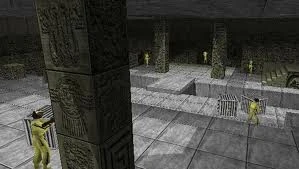
            The visuals of DM-Temple are very reminiscent of the Egyptian maps from Goldeneye007 and Perfect Dark. However, since the setting of the level takes place in a world infested by the Necris Black Legion, the map will combine traditional Egyptian and Necris textures, geometry, and static meshes; depending on what it available. DM-Temple will feature only the built-in effects in UE4. Plans for dynamically moving geometry have been made and may be incorporated in the event these plans would improve the overall gameplay experience. The level will feature music, sound effects fitting on a Team Deathmatch map, and we will be using audio assets that are already included in UE4.

Reference Images


Asset List
Name
Priority
Completed
None at this time

No


No


No


No

Feature List
Name
Priority
Completed
None at this time

No


No


No

My Professional Portfolio - http://tinyurl.com/kmsztl4
Follow me on Twitter - http://tinyurl.com/o3n5l2g
Follow Press Select Interactive on Twitter - http://tinyurl.com/pgfbvk8 

Derek holds a Bachelor's Degree in Game Design and has two and a half years of game development experience. To view his other work please visit www.dereksinex.com or his YouTube channel: https://www.youtube.com/user/JDKevlar
Tuesday, June 2, 2015

Let's Level Design! UE4 DM-Temple: Paper Map Finalization (Part 3)

Pre-Production

DM-Temple - Team Deathmatch Multiplayer Map built using UnrealEd 4


Hello and welcome to our new Let's Level Design tutorial series. In this episode we cover the critical thinking behind creating a multiplayer map in Unreal 4 (specifically player spawns and item placements to maximize gameplay flow), review key Photoshop tools, and how to use them to finalize a paper map.


My Professional Portfolio - http://tinyurl.com/kmsztl4
Follow me on Twitter - http://tinyurl.com/o3n5l2g
Follow Press Select Interactive on Twitter - http://tinyurl.com/pgfbvk8

Derek holds a Bachelor's Degree in Game Design and has two and a half years of game development experience. To view his other work please visit www.dereksinex.com or his YouTube channel: https://www.youtube.com/user/JDKevlar

Sunday, May 31, 2015

Let's Level Design! UE4 DM-Temple: Paper Map Part 2

Pre-Production

DM-Temple - Team Deathmatch Multiplayer Map built using UnrealEd 4


Hello and welcome to our new Let's Level Design tutorial series. In this episode we cover the critical thinking behind creating a paper map, review key Photoshop tools, and how to use them to create a paper map.


My Professional Portfolio - http://tinyurl.com/kmsztl4
Follow me on Twitter - http://tinyurl.com/o3n5l2g
Follow Press Select Interactive on Twitter - http://tinyurl.com/pgfbvk8

Derek holds a Bachelor's Degree in Game Design and has two and a half years of game development experience. To view his other work please visit www.dereksinex.com or his YouTube channel: https://www.youtube.com/user/JDKevlar

Friday, May 29, 2015

Let's Level Design! UE4 DM-Temple: Paper Map Part 1

Pre-Production

DM-Temple - Team Deathmatch Multiplayer Map built using UnrealEd 4


Hello and welcome to our new Let's Level Design tutorial series. In this episode we cover the critical thinking behind creating a paper map, key Photoshop tools, and how to use them to create a paper map.


Links referenced during the video:

Matthew Marquit's Level Design Tutorial Series - http://tinyurl.com/kxtlel5
Unreal's Channel (includes several tutorials) - http://tinyurl.com/pdoxqvb
Kerrigan's Campaign full paper map creation - http://tinyurl.com/l35mgpz
My Professional Portfolio - http://tinyurl.com/kmsztl4

Derek holds a Bachelor's Degree in Game Design and has two and a half years of game development experience. To view his other work please visit www.dereksinex.com or his YouTube channel: https://www.youtube.com/user/JDKevlar

Monday, May 11, 2015

Genre Discussion - First Person Shooter

First Person Shooter


            The First Person Shooter (FPS) genre and all of its sub/co-genres are my absolute favorite genre. As a youth, I played FPS games for hours upon hours and as an adult with very limited time I still play FPS games because this genre is the most time-flexible genre. At its core, FPS games give goals and rewards in short bursts whether it's in singleplayer or multiplayer and the gameplay is extremely addicting. Due to this infrastructure, consumers can play for multiple hours without getting fatigued and those of us with limited free time to play video games can play in short sessions with the same sense of reward; a unique selling point which no other genre can deliver. Unfortunately, this principle often turns into not giving the player a reason to invest emotionally into the game; other than functional gameplay and gameplay rewards. This unfortunate side-effect has led to massive criticism of FPS games because they severely lack good story-telling. Despite this, the First Person Shooter genre is arguably the most profitable video game genre which proves that gameplay matters more than story, regardless of what critics and consumers say.

            There are a lot of criteria that must be met for a game to be considered a "good" FPS. To start, the game must be a first-person game; a-la "First Person Shooter". However, since the game is in first-person, a large part of the experience boils down to player immersion since the game is played out essentially through the player's eyes as if they were actually in the game. Thus, player agency is a primary component to take a FPS game from "good" to "great". As the genre has evolved, the best practices of designing a good FPS game centralize around player agency and giving the player more control over their character. For instance, as the technology and industry grew, every video game included a story of some sort. In the early days every game included cut scenes or forced dialog to convey the story to the player, but this method strips control away from the player and destroys the immersive experience. Then in 1998, Half-Life revolutionized how story-telling was done in First Person Shooter games by getting rid of cut scenes. Of course, scripted events were still included and the designers cleverly crafted faux-cut scenes by putting the player in small areas where they couldn't get too far away from NPCs that progressed the plot. Even when the player did have the opportunity to miss vital information, the level design was so masterful that eventually any player could figure out what to do. Half-Life was responsible for giving agency back to the player inside of the FPS world and by giving player as much control as possible, immersion is streamed seamlessly through game sections with different pacing.

            The case of Half-Life and pacing also bring another aspect of what defines a good FPS; level design. Since First Person Shooter games are known and loved for their high octane combat, having great levels is a key for making a good FPS game. Levels need to portray a high level of interest and vary in goals while still holding key gameplay elements at heart. FPS games give developers a huge opportunity to experiment and do something great with their level design; a pillar which should be taken advantage of.

            Lastly, functionality and addicting gameplay are musts for a good FPS game. Tight controls and fun weapons keep players coming back hour after hour, level after level, and match after match. This final aspect of what defines a good First Person Shooter is why players remember GoldenEye 007 and Half-Life so fondly and why most players play the campaign for Call of Duty once, or not at all, and then just play multiplayer. In both GoldenEye and Half-Life the controls were simple to understand, there was a wide variety and functionality of weapons, levels/locations were unique from one another (more so for GoldenEye), and despite having essentially simple gameplay, levels allowed for unique objectives to be given to the player. In modern singleplayer campaigns the player just repeats the same objective over and over again which makes for a tedious experience. However, the simple, fun, and hard to master gameplay along with cool levels and a plethora of weapons is what makes modern FPS games worth playing in the multiplayer scene.

            I obviously believe that Half-Life  is one of the best examples of a First Person Shooter game, I have loved every single FPS game I have ever played. The beauty of the genre is every game has essentially the same gameplay, but every game is slightly different to make each one unique from each other. Likewise, in the 90's during a boom of FPS games (e.g. Doom, Wolfenstein, Quake, Duke Nukem, Serious Sam, Shadow Warrior, Half-Life, GoldenEye, Perfect Dark) every single FPS had the same mechanics, a large library of weapons, and the addictive gameplay of shooting guys in the face often. However, the art and level design was what really set them apart from each other.

            So in the modern age, consumers see a far less variety of quality FPS titles, but they are never-the-less money making juggernauts. Plus they're still massively fun. Unfortunately, with more complex technology and overall more complexly constructed games comes more bugs and glitches. This would not be such a bad problem if it weren't for release dates in order to actually make a return on investment; which has also skyrocketed. The increasing number of released games requiring patches after launch and the continuation of lackluster singleplayer stories make modern FPS games seem like a shell of their 90's brethren. These are surface problems though, and I still have the upmost faith in current and future FPS titles. As I stated earlier, I have never played an FPS game that I haven't loved and since this analysis is strictly about FPS titles I must remove games with sub and co-grenres like Fallout 3 (FPS/RPG), Team Fortress 2 (FPS/Co-op/Versus) and Payday 2 (FPS/Co-op) from the running and select a modern FPS game's singleplayer campaign. Which leaves us with Call of Duty: Advanced Warfare.

            I chose CoD:AW because it's the most recent pure FPS major title at the time of writing this analysis and it's a best example of the FPS genre. As common with all FPS games it features the same kind of mechanics players are all familiar with. The game is easy to play/understand, but hard to master and it features a new story; both of which makes it extremely inviting to new players. It also evolves old standards of FPS games by introducing new mechanics and customizations like grappling hooks, on-the-fly riot shields, and boosts. While these additions are new for the franchise, they are not new bits of gameplay for the genre. However, they are relatively new (within the last three years) and I believe we will continue to see these being the trend (as seen in upcoming games like Overwatch and Evolve). What makes Advanced Warfare really stand out from contemporaries are the little things that define a good FPS game. The graphics are phenomenal, they hired a superstar actor to voice and model the main antagonist, the story is compelling and does a great job of foreshadowing (albeit obvious for older/more mature players), and each level is unique both functionally and with the goals given to the player. For instance, the tutorial actually makes sense within the game world and isn't too patronizing which is a perfect balance for old and new players. One level has the player stealthily following an enemy target through a busy city, into small alley ways, then turns into a covert silent take-down of an enemy hideout, but the level ends in a massive chase straight out of a big-budget action movie. Then there are levels where the player pilots a drone which they use to clear a path for their A.I. teammates so they can capture a target. In short, Advanced Warfare takes advantage of what makes FPS games great and uses those limited tools to give the player a varied play experience through each level. This is a great change compared to the wave after wave of army lines the player had to fight through in earlier Call of Duty games where each level blurred together.

            To be perfectly honest, I cannot label any FPS game as a "worst example". It's almost as if FPS games are the easiest to get right. While I would refute any complaints about FPS games being buggy or having a terrible story, I do have a critique of games in this genre. Every First Person Shooter game does not hold up well over time. Most of the time it's because the graphic quality or the smoothness of the controls are just lackluster years later, but again, this is a testament to how great FPS games are because each new iteration makes improvements that make their amazing predecessors look and feel like garbage. However, I can still go back and play almost any old FPS game, even the original Wolfenstein and still have a blast. The only game I went back and played 10 years later that I thought "This is so terrible and unplayable." was GoldenEye 007. The thing to keep in mind though, was that I was playing it on my original N64 from 1998 on the original GoldenEye cartridge from 1998 on probably the worst controller ever designed. Having only one analog stick made the slow movement and combat infuriating because I was bogged down by ancient technology while the enemy A.I. was not. I can only blame myself and becoming so comfortable with having keyboard + mouse and dual analog sticks in order to move and aim in any direction at the same time.


Derek holds a Bachelor's Degree in Game Design and has two and a half years of game development experience. To view his other work please visit www.dereksinex.com or his YouTube channel: https://www.youtube.com/user/JDKevlar

Genre Discussion - Survival Horror

Survival Horror


            Survival Horror is an absolutely amazing genre. It is definitely a niche genre; much like their horror movie genre older brother, but survival horror games do garner some of the best praise and cult followings of any genre. However, the things that make a great survival horror game can also be a game's downfall (e.g. punishing the player too harshly for not playing the game as designed, not being scary enough, and overly convoluted objectives which leads to players not playing the game as designed) and why I have an immense love-hate relationship with survival horror games.

            For example, I love the Resident Evil franchise and I've played every iteration. Resident Evil 4 was the first game that set me on a long path of following online walkthroughs because, while the game is undeniably great, the gameplay objectives were extremely convoluted. In order to beat the game there were specific hidden collectables the player needed to find in order to unlock a specific pistol which then served as the gateway to successfully beating the game without wanting to throw your console out a window. Unfortunately, the first time I played the game I played it as I normally would, buying upgrades and new weapons which turned out to be a waste of time, money, and ammo as I couldn't get passed the first boss in the game. Again, the game gave no extrinsic effort to guide the player to obtaining the Blacktail pistol (the aforementioned pistol needed to beat the game) and put the player in situations where they had to fight huge hordes of enemies. In previous Resident Evil games, and essentially every survival horror game before RE4, the player had the choice in most cases of whether or not to engage in combat which made it easier/more intuitive for conserving your resources (a la survival horror). With the introduction of forcing the player to fight tons of enemies with the same limited resources, most players will deplete everything and be in a terrible position moving forward; often having to re-do sections or start the game completely over. This kind of practice is extremely frustrating and off-putting and only really devoted players will stick around, or look up how, to learn advanced techniques for completing these sections while still conserving resources. In the case of Resident Evil 4 and many subsequent games of a similar nature, this meant shooting enemies in the legs to either get them to stagger or fall over and then running up to do a quick time kick which also hits all enemies around the PC, or for the latter -- knife the enemy until they die. The player would then run away from enemies to get them into a bottle neck and repeat the process.

            Balancing resources available to the player, the difficulty of each player objective, and creating a scary environment which players want to continue to come back to, but also makes them terrified makes up a good survival horror game. Players need to feel overall impeded, but given enough hope that they can win. To accomplish this feat, good survival horror games have creepy looking enemies and obstacles which are stronger than the player and usually enemies that have grapple attacks rendering the player helpless for a few sections and requires panicked quick-time actions to set themselves free. To balance this, most enemies are either slightly slower or less maneuverable than the player so that the player can react, run, and counter-attack. If the player has the resources, they can eventually defeat any enemy/obstacle the game throws at them.

            Another big part of making a good survival horror game is the atmosphere. Lighting plays a huge part in setting a scary atmosphere, as does the sound, so concentrating on these two aspects is a must when designing the overall game; as well as, each level of the game. For instance, the original Silent Hill had some really simple opening level designs as it took place in the flat downtown center of a town. However, the lighting was really low, a fog covered almost all of the screen so the player could barely see in front of them, and eerie sounds played the entire time. Additionally, triggers were set to release enemies from off screen which surprises the player every time they play. As the player progresses, the level design starts to get more complex as they explore buildings in the town and the designers re-used many set pieces, but changed the lighting and textures to create kind of a "hell world" which added a lot of interest and variety to the game while optimizing resources on the development end.

            In the end, making a good survival horror game is like emulating the best horror films and placing the player into the main character's shoes.

            There are a ton of great examples of survival horror games from Sweet Home (which can be argued is more of an RPG), Alan Wake, to recent hits like Alien: Isolation and The Evil Within. In my experience, the studios that make survival horror games always do it well. So for the sake of argument let's discuss The Evil Within. The Evil Within does a perfect job of balancing the difficulty of the game with the amount of resources the player receives, it allows for multiple play types, and it delivers a unique horror atmosphere.

            Since Shinji Mikami (Resident Evil series, Dino Crisis series, Ace Attorney series, etc.) was at the helm, The Evil Within inherited everything that made Resident Evil 4 so amazing and improved the areas that were lacking. The objectives in the game are just vague enough to make it challenging and excited, while still giving the player enough to know what to do. There are also several sequences of the game which are red herrings -- e.g. the first time the player interacts with the main antagonist they are never harmed, but driven to run away; the next time the player encounters the antagonist he is an invincible force that will kill the player in one hit unless the player runs to a different section of the level. Furthermore, a special tip gets added to The Evil Within for it's cinematic sepia-like screen filter, which added to the extremely in-depth levels, creates an amazing horror feel and sense of progressing madness. Lastly, each mission objective is cleverly built into the level design. During one area of the game, the player is in a mansion reminiscent of Resident Evil 1 and the player starts by facing a large door with three locks which are connected to hoses which then run off into three different areas of the mansion. In order to unlock the door the player must complete a kind of brain dissection mini-game in each area. The mini-game itself is really clever because the solution to each puzzle is given to the player in the combinational form of an audio log and cross-section drawing of the brain. The player must drill into the correct section of the brain in order to complete the puzzle. Failure results in the player taking damage, but not killing them instantly; which is again, a perfect example of gameplay balance. While the player is running around completing these mini-games, they collect a plethora of items, finally gain a ton of knowledge of the story of the game, and must fend off enemies, traps, and the aforementioned invincible antagonist that will kill the player in one (melee) hit.   

            It's really difficult to find a "worst example" survival horror game, but I generally find a lot of indie/hobbyist, or student made survival horror games to be really lack-luster. Games like Slenderman and Five Nights at Freddy's come to mind if a specific game needs to be named. Both of these games are indeed scary and accomplish their intended goals. However, they lose their entertainment value very quickly because they are one dimensional games where the player has only one goal and the game is over within a few minutes. Slenderman and Five Nights both feature a single kill screen, limited gameplay, and rely entirely on jump scares to create a horror atmosphere because the player is in a single location the entire game.


Derek holds a Bachelor's Degree in Game Design and has two and a half years of game development experience. To view his other work please visit www.dereksinex.com or his YouTube channel: https://www.youtube.com/user/JDKevlar